Trusting the Thaw

March arrives quietly, often caught between winter’s lingering chill and spring’s first whispers. Snow may still cling to shaded corners. Trees may still appear bare. And yet—beneath the surface—life is stirring.

For caregivers and those living with grief, March often mirrors this in-between space. You may feel tired of the heaviness, longing for lightness, while still carrying deep emotional weight. “Trusting the thaw” is an invitation to honor this tender transition—to believe that healing is unfolding, even when it isn’t yet visible.

The landscape of the winter thaw does not arrive all at once. It happens gradually—drop by drop, root by root. In nature, this slow unfolding is essential. A sudden shift would overwhelm fragile ecosystems, including humans. I, for one, suffer greatly with allergies when the temperature shifts 30 degrees in one day, however, fortunately for the earth, it softens slowly, patiently allowing life to reawaken at a sustainable pace.

Grief and caregiving follow a similar rhythm.

There are seasons when emotional numbness protects us. When exhaustion wraps around us like winter’s blanket. When simply getting through the day feels like enough. And then—quietly—something begins to soften. A moment of laughter. A deeper breath. A spark of creativity. A desire to reconnect.

These moments do not mean grief is gone. They mean you are learning to carry it differently.

March reminds us that we do not have to rush our healing. We are allowed to thaw in our own time.

Daffodils & Laurel Leaf: Courage in Early Emergence

Among the first flowers to rise after winter, daffodils symbolize hope, resilience, and brave beginnings. They do not wait for perfect conditions. They bloom when the ground is still cold and storms still threaten; blooming occurs regardless.

Laurel leaf, long associated with inner authority and spiritual strength, complements this message. Historically linked to victory and wisdom, laurel reminds us that courage is not always loud or visible. Often, it is quiet persistence.

For caregivers and grievers, this courage may look like asking for help when you’ve always been “the strong one”. While this sounds easy, it is not, especially when you have been the one relying only on yourself for a long time. Setting boundaries around your energy is another hard one. Most empathetic and nurturing people struggling with boundaries. They want to be the fixer, the helper, the nurturer but I will tell you that if you set boundaries, you can rest without guilt, begin to tell the story about how hard this really is, and then the result is tenderness toward yourself. 

This is early emergence. This is quiet bravery. You do not have to be “fully healed” to move forward. You only need enough courage to take the next gentle step.

Trusting your inner authority in times of loss.

Grief can shake our sense of self. Caregiving can erode our confidence. When life revolves around crisis, illness, or loss, it becomes easy to forget that you still hold wisdom inside you.

March invites you back to your inner authority. This means learning to listen inward again and asking yourself these questions.

  • What does your body need today?
  • Where are you feeling depleted?
  • What brings even a small sense of peace?
  • What no longer feels sustainable?

You are allowed to honor these answers. Inner authority is not about control. It is about self-trust.

It is believing that your needs matter.
It is recognizing that rest is not weakness.
It is understanding that tending to your own spirit strengthens your capacity to care for others.

Just as laurel grows steadily, rooted and resilient, you are learning to grow into a new version of yourself shaped by love, loss, and lived experience.

Happy Spring!

Written by Lisa Story, MSCP, LPC, CT
Founder of Hope Grows

Focus of the Month: Trusting the Thaw
Essential Oil: Laurel Leaf
Flower: Daffodil

Breath and Softening

February asks very little of us—and that, in itself, can feel unsettling. This sure did apply with the latest storm that blanketed over 45 states recently. The calendar says winter is nearly over, yet the cold lingers. The light is returning, but not fast enough. We are told to look for signs of renewal while our bodies and hearts may still feel heavy, tired, or raw. This is often the month of holding on—not dramatically, but quietly. Breathing through what has not yet eased.

Our February focus is Breath & Softening, an invitation not to fix or push forward, but to gently support the nervous system as it carries grief, loss, caregiving fatigue, and the weight of uncertainty. It is about humility—acknowledging what we cannot control—and quiet resilience—the kind that does not announce itself, but endures.

When Winter Lingers in the Body

The nervous system is deeply influenced by season. Cold, darkness, and prolonged stillness can heighten stress responses, particularly for those already living with grief or caregiving demands. When loss is present, winter can amplify isolation and emotional numbness. When caregiving is ongoing, the body may never fully rest.

And sometimes, even when the snow rests beautifully on the branches of trees, there is no joy in the view. No peace. Just a sense of going on. This is where breath and softening matter—not as a cure, but as a form of companionship for the body.

Roman Chamomile: A Gentle Exhale

Roman Chamomile is known for its calming, soothing properties, particularly for the nervous system. Emotionally, it carries a message of reassurance—you are allowed to rest here.

Rather than energizing or uplifting, Roman Chamomile softens. It supports the parasympathetic nervous system, helping the body shift out of vigilance and into safety, even briefly. Inhaling the oil signals safety to the body and supports release. 

Roman Chamomile does not ask you to feel better. It simply helps you breathe where you are.

Violet: Humility and Quiet Strength

Violet grows low to the ground. It does not compete for attention. It thrives in shaded places and often appears when the cold has not fully loosened its grip. As a symbol, Violet teaches humility—not in the sense of diminishing oneself, but in accepting life as it is in this moment. It reminds us that resilience does not always look like courage or optimism. Sometimes resilience looks like tenderness. Like staying present when things hurt.

Violet is traditionally associated with the heart and with grief. It speaks to those moments when sorrow feels too heavy for words, when strength feels quiet and unseen.

In February, Violet reminds us that survival does not require joy. It requires breath.

Breath as a Bridge

Breath is one of the few tools that gently bridges the gap between adversity and endurance. When grief, loss, or caregiving overwhelm the system, breath offers a way to soften without surrendering. This is not about calming the mind. It is about letting the body know it does not have to brace every moment.

When the Beauty of Nature offers No Peace

There can be a quiet shame in not feeling comforted by nature when others say it should help. Snow-covered trees may be objectively beautiful, but grief can block access to wonder. Caregiving can drain the capacity for delight.

And that is okay.

Nature does not require us to feel anything specific. Winter teaches endurance through stillness, not through joy. Trees do not bloom prematurely because the calendar changes. They wait.

So can we.

February’s invitation is not renewal—it is softening into what remains unfinished. Breathing alongside what lingers. Trusting that humility and quiet resilience are not failures of faith or strength, but expressions of wisdom.

Even when peace feels absent, the breath is still available.
Even when joy does not arrive, softening can.

And sometimes, that is enough for now.

Written by Lisa Story, MSCP, LPC, CT
Founder of Hope Grows

Focus of the Month: Breath & Softening
Essential Oil: Roman Chamomile
Flower: Violet

Rooted Stillness: Honoring Winter’s Pause in Grief and Care

January arrives quietly.
The world is hushed beneath frost and shadow, inviting us into a slower rhythm—one that resists urgency and instead offers presence. At Hope Grows, this season reminds us that stillness is not absence or stagnation. It is a deeply rooted state of being, one that provides grounding, support, and spiritual anchoring—especially for those carrying grief.

For caregivers and those navigating loss, winter’s pause can feel uncomfortable. Our culture often pushes forward motion: healing timelines, productivity, “moving on.” Yet grief does not follow a straight path, nor does it respond well to pressure. Like the earth in winter, grief asks for rest, gentleness, and trust in what is quietly unfolding beneath the surface.

Rooted in Stillness, Not Alone

At Hope Grows, we believe that support does not mean fixing or forcing progress. It means creating space where grief can be held with compassion. Rooted stillness is at the heart of the care we offer—individual counseling, caregiver support, and grief-centered programming that honors where each person truly is.

Stillness allows us to be met, not managed.
It gives permission to pause without explanation.
It reminds us that rest itself is a form of resilience.

In winter, trees appear lifeless, yet their roots are actively gathering strength, anchoring deeply into the soil. In the same way, moments of stillness allow those in grief to reconnect with their inner foundation—values, memories, faith, and meaning that endure even after profound loss.

Nature as a Teacher in Grief

Nature consistently mirrors the rhythms of grief. Winter does not rush into spring; it trusts the process. Snow-covered ground protects what is dormant, not dead. Seeds wait patiently for warmth and light.

When we honor winter’s pause—through quiet walks, sitting beneath bare branches, or simply noticing the slower pace from our windows, we receive a subtle but powerful message: nothing is required of you right now except to be. For many who come to Hope Grows, this realization can be deeply relieving. Grief does not need to be explained or justified. It needs witness, safety, and time.

Frankincense: A Companion for Sacred Stillness

January’s essential oil, Frankincense, has long been revered for its spiritual and grounding properties. Its resinous aroma invites deep breathing and contemplation, helping calm the nervous system while opening space for reflection.

In grief, Frankincense supports the connection between body, mind, and spirit. It reminds us to slow our breath, soften our shoulders, and anchor ourselves in the present moment. Used in meditation, prayer, or quiet rest, it becomes a gentle companion—offering clarity without urgency, peace without the absence of pain.

At Hope Grows, we encourage simple rituals: placing a drop on the palms, inhaling slowly, and allowing the breath to settle. In these small moments, stillness becomes accessible—even in the midst of emotional complexity.

The Snowdrop: Hope Rooted in Cold Ground

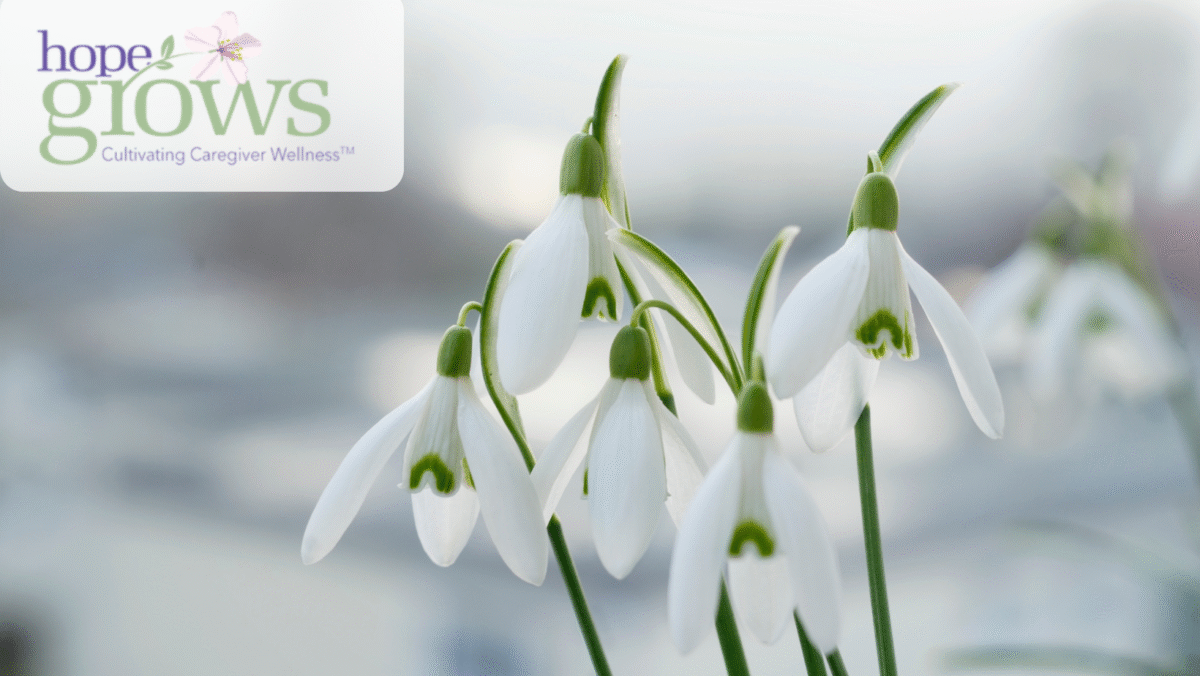
The Snowdrop, January’s flower, is a powerful symbol of rooted stillness. Emerging through frozen soil and snow, it does not bloom loudly or dramatically. Its beauty is quiet, humble, and persistent.

Snowdrops teach us that hope does not require ideal conditions. It often arrives softly, almost unnoticed, when the ground still feels cold. For those grieving, hope may not look like joy or optimism. Sometimes it looks like getting through the day, allowing tears, or accepting support.

At Hope Grows, we see Snowdrops everywhere—in caregivers who show up despite exhaustion, in mourners who continue to love despite loss, in moments of connection that feel small but meaningful. These are not signs of weakness. They are evidence of deep roots.

Honoring January’s Invitation

Rooted stillness is not about retreating from life; it is about returning to what sustains us. January invites us to release the pressure to “do” and instead allow ourselves to be held—by nature, by community, and by compassionate care.

As we move through this winter month, may you allow yourself moments of pause. May you trust that even in stillness, something meaningful is happening. And may you remember that at Hope Grows, you do not walk this season alone.

Like the Snowdrop beneath the snow and the quiet strength of winter roots, healing unfolds in its own time—deeply, faithfully, and with grace.

Hope Grows offers access to top quality essential oils, support groups, Grief Soup, mentorship, and mental health counseling. Contact us at 412-469-4673 or [email protected].—trusting that this season, like all seasons, carries its own kind of wisdom.

Written by Lisa Story, MSCP, LPC, CT
Founder of Hope Grows

Focus of the Month: Rooted Stillness
Essential Oil: Frankincense
Flower: Snowdrop

Beholding December: A Season of Stillness, Memory, and Gentle Light

As December arrives, I am reminded that the final month of the year often holds a unique mixture of tenderness and truth. The world around us grows quieter—winter skies fade earlier into darkness, cold air encourages us inward, and nature itself pauses, resting in a kind of holy stillness.

Beholding—a word that invites us not just to see, but to witness with intention. To behold is to pause long enough for awareness to surface. It asks us to approach ourselves, our memories, and the present moment with an open, steady gaze. And perhaps more importantly, it asks us to allow what is to be enough.

For many who are grieving, this quiet can feel comforting or confrontational. Sometimes both. The end of the year can carry with it the weight of memory for those carrying loss. December can stir up an ache of what is missing. There is a particular kind of poignancy to traditions we can no longer share, to rituals that now feel altered, to the placeholders at the table and the conversations left unfinished. Grief has a way of sharpening the contrast between what once was and what now is.

Turning towards Nature as the year draws to a close allows us to see that the natural world mirrors the emotional landscape of grief, and helps us positively focus. The earth is bare and resting, stripped of excess. Trees stand in their truth without foliage to hide behind. Winter does not rush. It waits, holds, breathes.

Yet, within that contrast, there is also the possibility of beholding—of lifting our eyes gently toward the moments of meaning still available to us.

Not to fix anything.
Not to force gratitude.
But simply to notice.

I like to focus on the strength and resilience of the evergreens—their majestic presence reminding us that even in the darkest, coldest months, life endures with quiet courage. The holly is another small miracle that arrives in the winter, with its glossy deep green leaves, bright red berries, and a presence that feels both protective and symbolic. Traditionally, holly has represented resilience and the promise of hope during the darkest time of the year. Its berries stand out against a barren landscape, reminding us that color and life exist even when the world feels cold and stripped down.

For caregivers and grievers alike, holly and evergreens can offer a tender lesson that even in deep dormancy, there can be signs of life worth beholding.

Its sharp, protective leaves also echo something true about grief. Loss teaches us boundaries. It teaches us to shield what is tender. And it teaches us that even the smallest burst of color—a memory, a breath of appreciation, a moment of warmth—can carry us through a difficult season.

Another thought to consider is the Essential Oil of the Month for December – Magnolia. Magnolia, with its soft, floral embrace, carries an energy of compassion and tranquility. Its aroma encourages us to soften the edges of our internal world, especially when grief feels jagged. Magnolia teaches the art of gentleness, both toward ourselves and the emotions that rise in December’s quiet reflection.

Paired with our focus of Beholding, magnolia offers an invitation: allow yourself to stand still long enough to sense the comfort that is available. Not the comfort that erases grief—but the comfort that accompanies it. In moments of overwhelm, inhaling magnolia can feel like placing a warm hand on the heart, reminding us that we are allowed to slow down and receive support.

Some last thoughts for this month’s focus: Beholding as a Practice with Loss does not require perfection. It simply requires presence. In your moments of heaviness this month, you may consider practicing the art of beholding in small, manageable ways:

  • Behold a memory—not to change it, but to honor it.
  • Behold the natural world—winter’s quiet landscapes often reflect our inner terrain.
  • Behold your breath—especially when emotion constricts the chest.
  • Behold small glimmers of warmth—a light in a window, a cup of tea, a bird perched on a bare branch.
  • Behold your own resilience—even if you don’t feel resilient in the moment.

Grief slows us down, sometimes against our will. Nature, in December, does the same. Both invite us into a slower, more reflective rhythm. Think of this thought as an invitation to let your gaze soften. Let your awareness rest on what is here—not what could have been or what should have been, but what is unfolding quietly in front of you.

And as holly brightens the winter landscape and magnolia calms the weary heart, may you find a gentle space to rest within yourself—trusting that this season, like all seasons, carries its own kind of wisdom.

Written by Lisa Story, MSCP, LPC, CT
Founder of Hope Grows

Focus of the Month: Beholding
Essential Oil: Magnolia
Flower: Holly