Botanicals of the Month: May

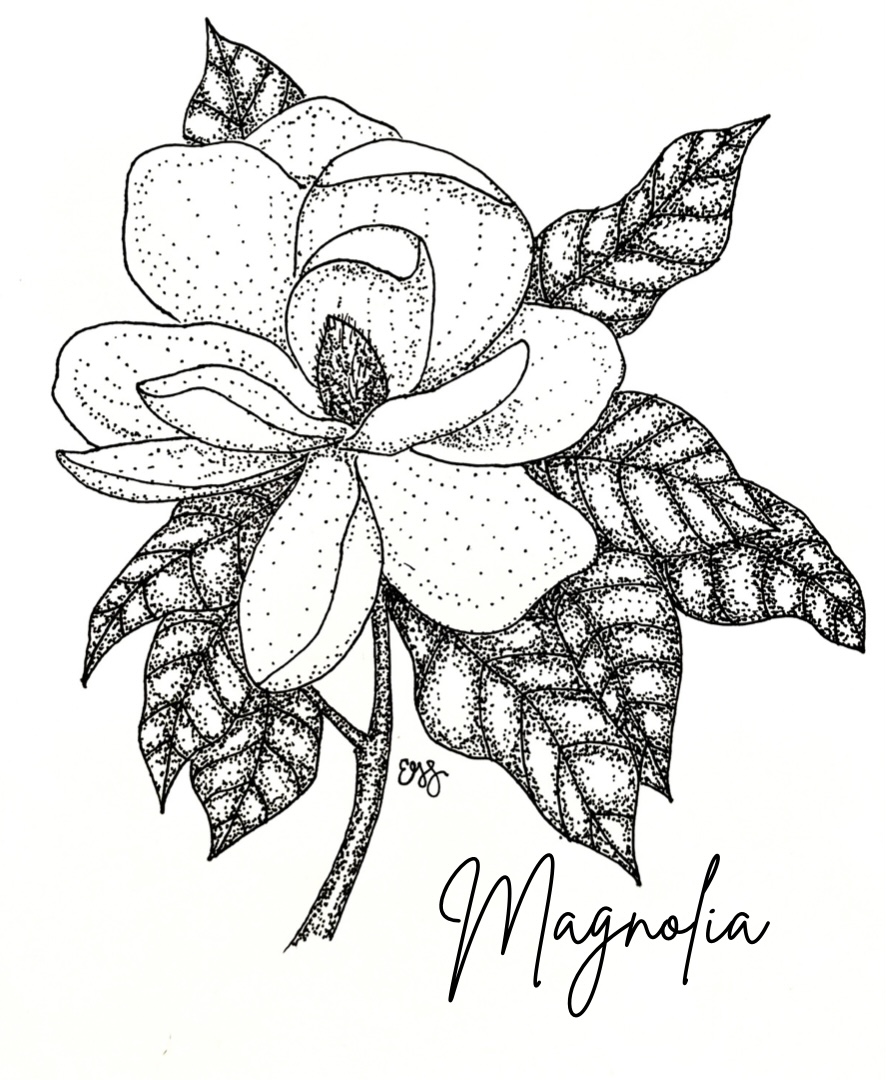
Flower of the Month: Chinese Magnolia a.k.a. Saucer Magnolia (Magnolia x soulangeana)
Doterra Essential oil of the Month: Magnolia Touch
Rishi Tea of the Month: Four Seasons Spring Oolong
Every spring, I eagerly await the blooming of the saucer magnolias. When it comes to flowering trees, this is a showstopper. I know where all the saucer magnolias are in my immediate neighborhood and try and visit them every spring. The large, unmistakable flowers, pink and purplish on the outside, unfolding to lily-white on the inside, start shedding their winter fur coats (bud scales) at the end of March. The tree is usually covered in blooms by mid-April, providing a welcome herald of spring. What an entrance!
The saucer magnolia flower stands for “love of nature,” symbolizing the harmony and co-existence of all-natural life. I don’t know how one couldn’t love nature when looking at one of these trees in full bloom. A saucer magnolia flower would serve as a perfect emblem for any naturalist. Bearing shades of both purple and pink, the flowers can also stand for love and romance (pink) and royalty, dignity, spirituality, good luck, and health (purple), depending on how they are used. If I were a young wizard in a wand shop out of Harry Potter, I would hope to go home with a saucer magnolia wand. It has been said that a magic wand made from the wood of a saucer magnolia will bring the magician closer to working with the core magic and spirits of ancient earth. And for anyone concerned about infidelity, put a saucer magnolia flower underneath the bed to endure faithfulness.
According to Feng Shui, planting a magnolia in the front of the house promotes tranquility inside, whereas planting one in the back of the house promotes slow, but sure, financial gain. In Chinese culture, the magnolia signifies purity and nobility. In Japanese culture, it stands for nobility, perseverance, and dignity. Recognized as a symbol of Yin energy, a magnolia flower is considered representative of feminine beauty and gentleness. Often used as a corsage flower, when given as a gift from a man to a woman, the message is “You are worthy of a beautiful magnolia.” And, in the Victorian era, magnolias were actually sent secretly as a sign of undying love and perseverance between those in a socially unacceptable love, like an aristocrat and a commoner.
Magnolias have also truly earned their right to stand as a symbol of endurance and longevity. Fossil remains have shown us that they have been around for at least 100 million years and were one of the first flowering plants to evolve on earth. While countless species have gone extinct in the past 100 million years, magnolias are true survivors, possessing remarkable adaptability to major environmental change. This could be one of the factors behind the phrase “steel magnolia,” which describes a southern woman who possesses all the attributes of beauty and feminine grace alongside great strength of character and independence of will.
Given that they evolved long before bees and butterflies, magnolias are pollinated by beetles, who feed on their protein-rich pollen. Botanically, the petals of a magnolia flower are actually a cross between petals and sepals, called “tepals.” Magnolia flowers are tinged with a heavenly fragrance and the essential oil can be used to cultivate self-love and calm anxiety or emotional turmoil. Traditional Chinese medicine uses magnolias to help with headaches, lung problems, digestive problems, and insomnia. Teas are made from both the flower buds (with fur coats still on) and the bark. Hope Grows’ three saucer magnolias all bloomed beautifully this year. The photos included here are from the one in the Garden of Rest. If, by chance, you find yourself admiring a magnolia tree in bloom one day, remember you are looking at a genuine survivor of the ages, reminding us all to stop and appreciate the ever-evolving beauty and harmony of the natural world.