Autumn Equinox Reflections: Tethered in Transition 

Look out your window.

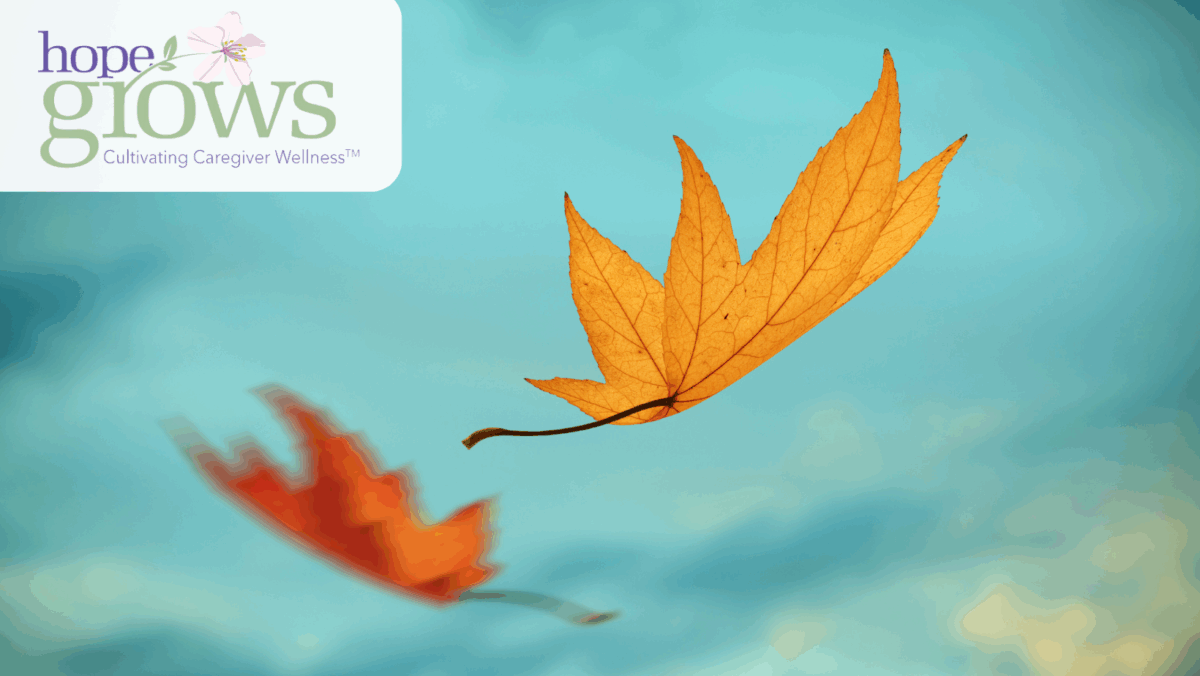
Every falling autumn leaf is a tiny kite

with a string too small to see

held by the part of you

in charge of making beauty out of grief.

-Andrea Gibson

Autumn is often described as a season of letting go, but late poet Andrea Gibson shifts that perspective: the leaf is not severed, it’s tethered. Even as it drifts, it remains bound by an invisible string to “the part of you in charge of making beauty out of grief.” This reframes loss as continuity rather than absence. The autumn equinox, too, is not simply a point of light diminishing but a hinge moment. In caregiving and grief, this resonates deeply: the people we love don’t simply “fall away.” Their lives, rituals, or even the exhaustion and tenderness of caregiving remain tethered in memory, shaping us. What’s lost still pulls on us, even if the string is too fine to see. Gibson’s leaf-as-kite image shows autumn as a season of staying tethered in invisible ways. That’s exactly what the equinox is: a balance point we can’t quite see, but that still holds us. 

Summer often drives us outward into endless lists and tasks fueled by long daylight hours. I always start summer with a long list… that I never quite complete. The abundance of light can feel like pressure to do more, achieve more. Autumn arrives as a gentle course correction. Days shorten, and instead of “get it all done,” the season invites us to ask: What’s worth gathering in? What matters most to keep tethered before the darkness deepens? Where summer stretched us into endless doing, autumn invites us into choosing—what do we gather in, what do we let lie, what invisible strings do we honor before the darkness deepens? 

“Equinox” comes from the Latin aequus (equal) and nox (night). On this day, night and day are nearly the same length. The balance is fleeting—it tips almost immediately. This teaches us that equilibrium isn’t permanent, but a moment we pass through. What a kindness this revelation is. 

My soul expands whenever nature surrounds me. This morning, the scent of fall was on the breeze. It was a mix of damp, pre-rain air, dying leaves, late-summer blooms, and something I can’t quite name. While September often feels like an extension of summer, this morning felt right. Something deep in my soul reached toward the autumnal pull and found a friend, a compassionate knowing in the shifting season. I exhaled into the dark gray blanket, and it surrounded me with the comfort of a mother. Nature has a way with us, doesn’t she? 

When I left my house an hour earlier, the sky was ablaze—the kind of sunrise granted only on bright mornings before a storm. Summertime streaked the sky in pinks, oranges, purples, and reds. The cozy gray of autumn swallowed the colors whole, and my soul exhaled.  

Autumn carries a feeling of liminality. It is neither hot nor cold, but it can be each at times. It begins fully green and ends fully bare, delivering its bounty to carry us through cold, dark months. Autumn is a season of unveiling, of showing what’s been inside all along. Leaves reveal hidden colors as chlorophyll breaks down. Symbolically, this is powerful: the green of summer isn’t lost; it’s stripped away, allowing what was always there to shine in red, orange, and purple brilliance. Fall’s palette isn’t just beauty before death. The hues are truth revealed at the moment of transition. 

The gentleness of fall steadies us… if we choose to embrace it. Yes, it signals the approach of barren cold, but it is also mild and gentle. It doesn’t scorch or freeze. It allows for natural release, quiet dying, lingering goodbyes. The leaves that fall to reveal bare branches create a blanket over the hard, dusty ground, promising nourishment for the growth to come. What we let go of during our fall seasons isn’t lost forever. As it disintegrates into the ground, its lessons, wisdom, and richness soak into the places that will sprout new life. Whether losses or gains, highs or lows, failures or successes, the things we shed in preparation for life’s darker seasons become the nourishment that will emerge again in the spring. 

“To let go, I allow life’s brevity to be its magic.

Another line inspired by Andrea Gibson, a masterful weaver of words whose life on earth ended this past July, one month shy of 50 years old. These words reorient me on days that pass too quickly. If we don’t let go, we drag the past into the coming winter. Rather than nourishing the ground as it naturally falls apart, it becomes deadweight, frozen in place.  

We can be afraid and unravel chaotically, or we can trust the process, embrace letting go, and believe the things we’ve held onto will become the nourishment that brings forth tomorrow’s beauty. We can bemoan the cooler temperatures and dead leaves underfoot, or we can see these days as gifts—a cushion between the heat of summer and the cold of winter, a time to prepare for all that is to come. 

Sometimes a season ends long before we notice. We don’t always get to choose our “lasts.” We don’t always know. Tomorrow looms mysterious—that’s a universal truth. There are always looming goodbyes, in every season. We just don’t always get to know what they will be. Lasts are so hard… and so are firsts. Both are necessary components of living, moving, and being. 

And we will be asked: Are you willing? Are you willing to step into this change, this new chapter, this new season? Sometimes the question has the audacity to come after the change—it doesn’t ask our permission before shaking our comfortable lives. Sometimes it must… because we’d never choose it for ourselves, even if it’s what we need. 

I want to exist in the present without sacrificing the beauty of the past or my hope for the future. I want to continue to learn how to dance in the both/and of grief and gratitude, to swim in the waters of tension and unknowing with a heart that trusts and says yes to what comes next. Like the light and dark of the equinox, these are realities that can be held simultaneously. 

Written by Laura Gamble
Clinical Administrative Coordinator
Collaborative Healing

In a world where the landscape of caregiving continues to grow more complex, the need for collaborative, holistic approaches to mental health has never been greater. Families caring for medically complex individuals are often navigating a terrain of emotional exhaustion, grief, and chronic uncertainty. These caregivers are not only managing physical care but are also wrestling with questions about meaning, suffering, and identity—questions that existential therapy invites us to explore.

When we layer this therapeutic lens with the principles of collaboration and the healing reciprocity found in nature, we begin to see a multidimensional approach to caregiver support: one that doesn’t just treat symptoms but honors the whole human experience.

September carries with it a quiet shift; the angle of sunlight softens, the days grow shorter, and the air turns crisp with early hints of autumn. Nature, once ablaze with summer’s fullness, begins its slow descent into stillness. This seasonal threshold is very similar to the emotional and psychological shifts experienced by those caring for someone with medically complex needs. In fact, this natural turning point offers profound metaphors and opportunities for reflection.

The Existential Terrain of Caregiving

Existential psychotherapy centers around the human experience of meaning, isolation, freedom, responsibility, and mortality. For caregivers of medically complex individuals—whether a child with a rare genetic condition or a partner with a progressive illness—these themes aren’t theoretical; they are lived realities.

Caregivers may silently ask:

  • Why is this happening to someone I love?
  • What is my role in this?
  • Who am I beyond this responsibility?
  • Will life ever feel “normal” again?

Existential theory acknowledges that these questions don’t necessarily have clear answers. Instead, healing comes in exploring them together—with a therapist, within a support group, or through personal reflection in nature. When we stop trying to escape the pain and begin to witness it, transformation can begin.

The Power of Collaborative Mental Health Support

Supporting caregivers in isolation is not enough. Just as caregiving itself is collaborative—coordinating with physicians, specialists, therapists, and sometimes even educators—so too must be the model of mental health care. Collaboration between psychotherapists, medical professionals, support organizations, and families ensures that care is both informed and person-centered. This is the model with which Hope Grows, The Iris Respite House & Healing Gardens, and The Root of Good Care Counseling practice offer caregivers. The Hope Grows Model of Care doesn’t promise to erase suffering, but it does offer the scaffolding for caregivers to live through suffering with meaning, connection, and moments of peace.

Collaborative care within the medical/mental health community at its core is a reminder than none of us are meant to carry our burdens alone.

  • Therapists integrating psychoeducation on chronic stress, traumatic responses, and compassion fatigue.
  • Physicians recognizing the psychological toll on caregivers and referring appropriately.
  • Nonprofit organizations offering therapeutic horticulture, respite programs, or grief-informed services.
  • Mentorship/Mentee programs offering a connection for past caregivers to be a guiding voice to those currently caregiving. The Caregiver2Caregiver program at Hope Grows helps to connect individuals in this way.
  • Caregivers themselves participating in their own mental health planning, empowered to voice their needs.

Nature as a Therapeutic Partner

Alongside professional collaboration, there exists a quiet, enduring collaborator: nature.

Nature offers more than just a setting for respite—it mirrors existential truths in ways that gently support integration and healing. The natural world does not deny the cycles of birth, growth, decay, and death. It embraces them, honors them, and allows them to unfold.

Caregivers often report feeling grounded when taking their shoes off and pressing the bare feet into the earth, digging in the earth, or simply watching birds. These aren’t small moments; they are sacred exchanges. Nature gives us permission to slow down, breathe, and witness life unfolding without expectation.

This reciprocal relationship is powerful. As caregivers give of themselves, nature gives back—through beauty, stillness, or a seasonal metaphor. If you experienced tending a garden this season, the act of gardening can reflect the process of tending to one’s own inner life. Last but not least, considering the seasonal change from winter to spring: the return can echo the hope that life, even when altered, still holds possibility.

Closing Reflections

To truly serve medically complex caregivers, we must weave these threads—existential theory, collaborative therapy, and the natural world—into an integrated framework.

At Hope Grows, we believe healing is not a linear path, nor is it one that any person should walk alone. When we collaborate across disciplines and include the natural world in our caregiving and therapeutic practices, we honor the full spectrum of human experience—pain, purpose, and presence.

In the quiet moments among the trees, in the shared tears during counseling, and in the courageous questions caregivers ask each day, we find a profound truth: healing is not always about fixing; sometimes it’s about holding space, together.

Written by Lisa Story, MSCP, LPC, CT
Founder & Clinical Director

Focus of the Month: Collaboration
Essential Oil: Neroli
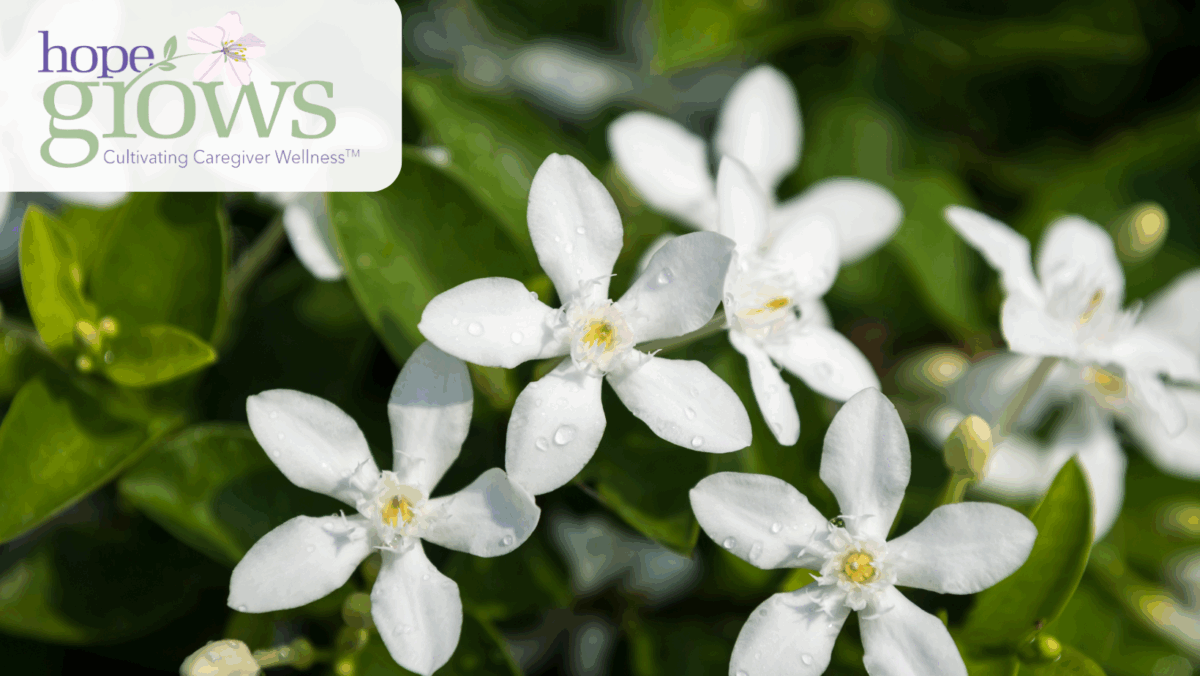
Flower: White Jasmine

Stretching Yourself in Grief

In August, as summer begins to exhale its last full breath, the world around us slowly starts to quiet. The heat lingers, but the light subtly shifts. Gardens begin to dry. Cicadas sing their steady chorus. Nature gives us signs that change is near.

And in this seasonal in-between, there is an invitation: to stretch yourself.

Can I Get Paid to Care for My Child With Disabilities?

At Hope Grows, we walk alongside caregivers who give so much of themselves, often at great emotional, physical, and financial cost. While our mission centers on nurturing mental, emotional, and spiritual wellness through therapeutic respite and nature-based care, we know that financial strain is a very real part of many caregiving journeys.

From time to time, caregivers ask us: “Can I be paid to care for my ⁠child with disabilities?” And while we don’t directly provide financial support or legal guidance, we’ve created this guide as a compassionate resource to point caregivers toward programs and possibilities that may offer relief.

Much like compensation for parent caregiving, getting paid to care for your child with disabilities allows you to keep doing what you know is the right thing for your child.

Disclaimer: This article is intended to offer general guidance and support, not legal or financial advice. As programs and benefits vary widely depending on your location and situation, we encourage you to reach out to a local social worker, legal advisor, or your state’s Medicaid office for personalized assistance.

Why Seeking Support Matters: The Dangers of Caregiver Burnout

If you feel overwhelmed, know this: you’re not alone. According to The Cleveland Clinic, caregiver burnout is a state of mental, emotional, and physical exhaustion that results from taking care of someone else. 

Millions of parents in the U.S. care for their children with disabilities, often putting in full-time hours each week. Balancing those demands with financial strain can feel like carrying too much for too long.

At Hope Grows, we see this every day. The exhaustion, the quiet worry, the weight of giving so much. You deserve support, not just financial, but emotional and spiritual, too. That’s why we’re here: to help lighten the load, in all the ways that matter most.

How to Get Paid to Care for Your Child With Disabilities: Financial Support Options

Many families caring for children with disabilities wonder if there’s financial support available for the critical care they provide at home. While every situation is different, there are several common programs worth exploring:

Getting Paid Through Medicaid Waivers

Many states offer Home and Community-Based Services (HCBS) waivers that sometimes allow family members, including parents, to be paid caregivers. These waivers are intended to help individuals with disabilities remain at home rather than being placed in institutional care. Coverage and eligibility vary by state, but this is often one of the most direct ways to receive compensation for caregiving.

Resource: Medicaid Waivers Directory

Getting Paid Through Supplemental Security Income (SSI)

SSI is a federal program that provides monthly payments to children with disabilities from low-income households. If your child meets both the disability and income criteria, your family may qualify for ongoing support. These funds can help offset some of the everyday expenses associated with caregiving.

Resource: SSI For Children Eligibility Information

Getting Paid Through State-Based Caregiver Programs

In addition to Medicaid waivers, many states have separate programs that provide financial or practical support to family caregivers. These might include direct stipends, training, or respite services. The availability of these programs can depend heavily on your state’s policies and budget.

Resource: State Medicaid Support Directory

Getting Paid as a Caregiver Through Veterans Directed Care

If your child is an adult and a veteran, the Veterans Directed Care program allows them to manage their own care budget. This includes hiring a family member—like you—as their caregiver. It’s a flexible option that supports independence while offering financial relief.

Resource: Veterans Directed Care Overview

Financial Help From Nonprofit or Community-Based Caregiver Resources

Various nonprofit organizations offer caregiver grants, stipends, or respite care funding, especially in times of acute need. These support options are usually smaller in scale, but they can be a lifeline during transitions or seasons of overwhelm. At Hope Grows, we understand that not all support needs to come in financial form. 

For those unable to travel or afford overnight stays, we offer our healing gardens, 14 distinct, therapeutic spaces at the Iris Respite House, freely as a place of reflection, restoration, and peace. Whether you need a moment to breathe or a gentle reminder that you’re not alone, we welcome you to explore these gardens from wherever you are.

Take a virtual walk through our gardens.

As these programs change over time, it’s best to contact a local social worker or disability advocate who understands the latest in your region.

How To Get Paid For Taking Care Of Your Child With Disabilities

Navigating the world of caregiver compensation can feel overwhelming, but it doesn’t have to start with a perfect plan. Here’s how to take meaningful first steps toward understanding your eligibility and accessing support:

  1. Start by Gathering Documentation: Keep a detailed log of the daily care you provide. This includes medical tasks, therapy support, transportation, emotional care, and household duties. This documentation will be important if you apply for financial assistance.
  2. Research Programs in Your State: Every state is different. Look into your state’s Medicaid office or Department of Human Services to see which programs you may qualify for. 
  3. Contact a Local Social Worker or Advocate: These professionals often know the latest program updates and how to navigate the system efficiently. Don’t be afraid to ask questions or request guidance; they’re here to help.
  4. Reach Out to a Hospital or Care Team: If your child receives regular medical care, ask the care team if a case manager or hospital social worker can support you in applying for caregiver resources.
  5. Connect with a Nonprofit or Peer Community: Groups focused on disabilities or family caregiving often have real-time insights and encouragement from others who’ve walked a similar road. Social workers, hospital case managers, and local nonprofits can be powerful allies in helping you understand your options.

You Are Not Alone

While financial support is a lifeline, it’s only one piece of the caregiver puzzle. Your mental and emotional health matters deeply. At Hope Grows, we understand the weight that caregivers carry. Through our nature-based therapies, counseling services, and respite programs, we support caregivers just like you.

Whether you live near our gardens or join us virtually, we welcome you into a compassionate community that sees and honors the work you do.

If you feel overwhelmed or alone, please reach out. You deserve support. ⁠To learn more about how Hope Grows can support your caregiving journey, reach out today.

Held in the Heart of Grief

Grief, in its truest form, is not a problem to be solved or a wound to be quickly bandaged. It is a sacred unfolding, an experience of love’s deepest cost. It can feel raw and relentless—like waves crashing against the shore of our very being. And in those crashing moments, it’s easy to feel like we’re unraveling. That we are completely, utterly alone.

But grief, while deeply isolating, also carries within it a quiet truth: we are meant to be held.

What the Light Reveals: A Summer Solstice Reflection

The rain is falling in sheets as I glance up from my computer screen—a scene that’s become a bit repetitive this spring. This has been the wettest season I’ve seen since we moved here, and the clouds just keep coming. I find myself thinking about the upcoming summer solstice—the longest day of the year, when the sun reaches its highest point in the sky—and wondering: how are we already here? It feels like the spring equinox was just a few weeks ago. Time is rushing, and I’m struggling to catch my breath.

There’s a part of me that’s irritated by the rain—how it traps us indoors, delays garden work, thwarts the ever-growing to-do list. But there’s another part that’s oddly grateful. The rain has made the list a little shorter today. Nature, in all its wild unpredictability, can disorient us—but also reorient us. A heavy downpour might feel like an intrusion, but sometimes it’s exactly what we need to pause, to breathe, to recalibrate.

That reorientation happened to me once during a family camping trip, in the form of a summer thunderstorm. Fifteen or twenty of us, from babies to grandparents, set up camp in the beautiful Bighorn mountains near Buffalo, Wyoming. We were enjoying riding four-wheelers, fishing, and fort-building one afternoon, until the summer sky unleashed its fury. Thunder, lightning, whipping wind, and torrential rain halted our afternoon activities. We rushed to the campers to get out of the weather. The sky became so dark we lit lanterns in the campers, and we played cards, ate snacks, and engaged in deep conversations for a few hours while rain pelted the windows. The things we talked about might never have come up had we not been forced into tight quarters all together. We learned things about each other, felt seen and heard by our closest people, and learned a few new card games, too.

That storm taught me that sometimes, when we’re forced to slow down, something else—connection, insight, healing—can emerge. I’ve seen that truth mirrored again and again in caregiving. During seasons of caregiving, days don’t often pause unless they’re interrupted. But when they are, we might find—like I did in that camper—that there’s more waiting inside us than we realized.

Caregivers often live by lists. We plan, prepare, move forward, check the next thing off. That rhythm gives us structure, and sometimes, a sense of control. But there are things in life that don’t fit neatly on a list—emotions too complex, griefs too heavy, questions too big. So, we tuck them away into what I’ve come to think of as the black holes of the soul: tiny internal spaces that seem to hold everything we don’t have the capacity to process.

NASA describes a black hole as a place in space where gravity pulls so strongly that even light can’t escape. It’s a collapse of matter into a small, dense point—so dense, in fact, that it becomes invisible. I wonder if we carry these places inside us—emotional singularities, where the important things we don’t want to feel are crammed into hidden corners, packed tightly until their gravity becomes impossible to ignore.

On the busiest days, when we’re rushing from one responsibility to the next, those inner black holes stay sealed. But what happens when life pauses us—when we’re metaphorically forced indoors by a storm? When that stillness comes, so too can the reckoning.

Unlike in space, the black holes within us are not inescapable. Sometimes all it takes is a breath, a moment of quiet, for what’s been buried in darkness to rise to the surface and ask for our attention.

The summer solstice is its own kind of paradox. It marks the height of light, but also the turning point—the day after which each one grows a little shorter. On this peak day, we are reminded that expansion and retreat coexist. That growth is always followed by rest. That the arc of light, like the arc of our own lives, is cyclical.

In many spiritual traditions, the solstice isn’t just about the outer sun—it’s also about the inner fire. That vital, creative, truth-telling spark within us. This is a time for illumination—when what’s been hidden or unconscious is invited into full light, when we are called to reveal, the theme we’ve been exploring this month. Maybe this summer solstice is the invitation we’ve been waiting for to pull all that matters out of the black holes of our souls, to let the light of longer days penetrate the parts of us we’ve shoved into the dark.

When we’re caregiving, our inner fire often gets buried beneath the weight of responsibility, and over time, our creativity and vitality can begin to dim. It’s easy to believe we’ve lost ourselves entirely. When a season of caregiving ends—whether suddenly or slowly—it can feel disorienting. In those tender moments, retreating into the black holes of the soul may feel like safety, a place to hide while we figure out who we are now. But just like the gardens bursting into bloom after months of rain and shadow, we aren’t made to live in perpetual darkness. Something within us always reaches for the light, even as our roots continue to grow in the unseen soil.

Perhaps this summer solstice offers us an invitation: to come into the sun’s warmth and let it touch the places within us that have gone cold. At first, that light might feel harsh—we may instinctively shield our eyes, unaccustomed to its brightness. But it is as much a gift as the quiet dark of winter, which offers us retreat, rest, and reprieve. We were made for both. To thrive, we must allow ourselves the full cycle—the rooting and the rising, the dark and the light.

At Hope Grows, the gardens are responding to this season with wild generosity. The annuals and perennials are blooming, the greenery is lush, and the scent of fresh soil greets us at every turn. We’re in full swing with programming—support groups, children’s camps, events, and longer days in the garden. This is a season of fullness, of joy, of activity.

And still, the rain falls.

Stillness interrupts the pace. The storms give us space to tend not just the land, but our inner landscapes—to acknowledge what’s been stored away and allow the warmth and light of the season to touch even the parts we’ve hidden from ourselves.

This solstice, may we take a cue from nature—boldly blooming, even while surrendering to cycles beyond our control. May we notice what’s asking to be revealed. May we pause long enough to let the light in.

Written by Laura Gamble
Clinical Administrative Coordinator